看板 CityNight
作者
標題 [筆記] 拉丁文發音 #語言學
時間 2016-01-25 Mon. 22:01:42
作者
標題 [筆記] 拉丁文發音 #語言學
時間 2016-01-25 Mon. 22:01:42
b
b
d
d
f
f
g
g
In Classical Latin, ⟨c g t⟩ are always pronounced hard, as /k g t/.
h
h
Generally silent. Sometimes medial ⟨h⟩ was silent in Classical Latin.
j
i
In Classical Latin, ⟨i u⟩ represented the vowels /ɪ iː and /ʊ uː/, and the consonants /j/, and /w/.
Between consonants, and when marked with macrons or breves, ⟨i u⟩ are vowels. In some spelling systems, /j w/ are written with the letters ⟨j v⟩. In other cases, consult a dictionary.
In Classical Latin, consonantal ⟨i⟩ between vowels stands for doubled /jj/: cuius [ˈkujjʊs].
The vowel before the double /jj/ is short, though it is sometimes marked with a macron. When a prefix is added to a word beginning in /j/, the /j/ is usually single: trā-iectum [traː.jɛkˈtũː].
k
In Classical Latin, ⟨c g t⟩ are always pronounced hard, as /k g t/.
k
c
In Classical Latin, ⟨c g t⟩ are always pronounced hard, as /k g t/.
kʰ
ch
kʷ
qu
The labialized velar /kʷ/ was pronounced as labio-palatalized [kᶣ] before the vowels /ɪ, iː, ɛ, eː/, as in qvī [kᶣiː].
l
l
ɫ
l
/l/ had two allophones in Classical Latin: velarized [ɫ] at the end of a word or before another consonant, plain [l] in other positions.
m
m
In Classical Latin, a vowel and ⟨m⟩ at the end of a word, or a vowel and ⟨n⟩ before ⟨n⟩ or ⟨f⟩ represents a long nasal vowel.
n
n
In Classical Latin, a vowel and ⟨m⟩ at the end of a word, or a vowel and ⟨n⟩ before ⟨n⟩ or ⟨f⟩ represents a long nasal vowel.
ŋ
n
In Classical Latin, a vowel and ⟨m⟩ at the end of a word, or a vowel and ⟨n⟩ before ⟨n⟩ or ⟨f⟩ represents a long nasal vowel.
ŋ
g
The digraph ⟨gn⟩ is pronounced as [ŋn] in Classical Latin.
p
p
pʰ
ph
r
r
s
s
t
t
In Classical Latin, ⟨c g t⟩ are always pronounced hard, as /k g t/.
tʰ
th
w
u
In Classical Latin, ⟨i u⟩ represented the vowels /ɪ iː and /ʊ uː/, and the consonants /j/, and /w/.
Between consonants, and when marked with macrons or breves, ⟨i u⟩ are vowels. In some spelling systems, /j w/ are written with the letters ⟨j v⟩. In other cases, consult a dictionary.
In Classical Latin, consonantal ⟨i⟩ between vowels stands for doubled /jj/: cuius [ˈkujjʊs].
The vowel before the double /jj/ is short, though it is sometimes marked with a macron. When a p
v
v
z
z
a
a
aː
ā
ɛ
e
eː
ē
ɪ
i
iː
ī
ɔ
o
oː
ō
ʊ
u
uː
ū
ʏ
y
yː
y
ae̯
ae
oe̯
oe
au̯
au
eu̯
eu
ui̯
ui
◌̃ː
Vm
◌̃ː
Vn
- - - - - - - -
b
b
d
d
dz
z
dʒ
g
In Ecclesiastical Latin, ⟨c g sc⟩ are pronounced as soft [tʃ dʒ ʃ] before the front vowels ⟨e i y ae oe⟩, and ⟨ti⟩ before a vowel is pronounced [tsi].
f
f
g
g
h
h
Generally silent. Sometimes medial ⟨h⟩ was pronounced [k] in Ecclesiastical Latin (e.g. mihi).
j
i
In Ecclesiastical Latin, ⟨i⟩ represents the vowel /i/, ⟨j⟩ represents the consonant /j/, ⟨u⟩ represents the vowel /u/ or /w/, and ⟨v⟩ represents /v/ in Ecclesiastical Latin.
k
k
k
c
l
l
m
m
n
n
ŋ
n
ɲ
gn
p
p
r
r
s
s
In Ecclesiastical Latin, /s/ between vowels is often pronounced as [z].
ʃ
sc
t
t
ts
t
In Ecclesiastical Latin, ⟨c g sc⟩ are pronounced as soft [tʃ dʒ ʃ] before the front vowels ⟨e i y ae oe⟩, and ⟨ti⟩ before a vowel is pronounced [tsi].
tʃ
c
In Ecclesiastical Latin, ⟨c g sc⟩ are pronounced as soft [tʃ dʒ ʃ] before the front vowels ⟨e i y ae oe⟩, and ⟨ti⟩ before a vowel is pronounced [tsi].
w
u
In Ecclesiastical Latin, ⟨i⟩ represents the vowel /i/, ⟨j⟩ represents the consonant /j/, ⟨u⟩ represents the vowel /u/ or /w/, and ⟨v⟩ represents /v/ in Ecclesiastical Latin.
In Ecclesiastical Latin, consonantal ⟨v⟩ is pronounced as a fricative /v/, except in the combinations ⟨gu su qu⟩, which are pronounced /gw sw kw/.
z
s
In Ecclesiastical Latin, /s/ between vowels is often pronounced as [z].
ɛ
ae/æ
ɛ
oe/œ
ɛ
e
i
i
ɔ
o
u
u
au̯
au
eu̯
eu
ui̯
ui
https://en.wikipedia.org/wiki/Help:IPA_for_Latin
--
※ 作者: Ctea 時間: 2016-01-25 22:01:42
※ 編輯: Ctea 時間: 2016-01-26 22:16:13
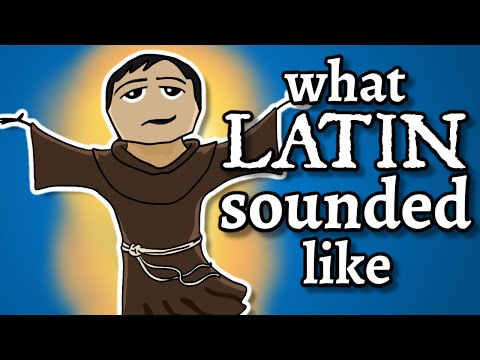
https://www.youtube.com/results?search_query=what+latin+sounded+like
https://www.youtube.com/watch?v=_enn7NIo-S0
What Latin Sounded Like - and how we know - YouTube
Classical Latin went extinct, yet we still know how to pronounce it. Proof! Subscribe for language:
Classical Latin went extinct, yet we still know how to pronounce it. Proof! Subscribe for language:
※ 編輯: Ctea 時間: 2019-09-21 02:55:26 (台灣)
https://www.ezglot.com/words-ending-with.php?w=k&l=lat&l2=ita&length=&submit=Search
#字尾查詢
※ 編輯: Ctea 時間: 2019-12-21 04:42:51 (台灣)
https://en.wikipedia.org/wiki/Hard_and_soft_G
https://en.wikipedia.org/w/index.php?title=Hard_and_soft_G&oldid=1323378226
In the Latin-based orthographies of many European languages, the letter ⟨g⟩ is used in different contexts to represent two distinct phonemes that in English are called hard and soft ⟨g⟩. The sound of a hard ⟨g⟩ (which often precedes the non-front vowels ⟨a o u⟩ or a consonant) is usually the voiced velar plosive [ɡ] (as in gain or go) while the sound of a soft ⟨g⟩ (typically before ⟨i⟩, ⟨e⟩, or ⟨y⟩) may be a fricative or affricate, depending on the language. In English, the sound of soft ⟨g⟩ is the affricate /dʒ/, as in general, giant, and gym. A ⟨g⟩ at the end of a word usually renders a hard ⟨g⟩ (as in "rag"), while if a soft rendition is intended it would be followed by a silent ⟨e⟩ (as in "rage").
via https://gundam.fandom.com/wiki/Gigi_Andalucia
Gigi's name is pronounced with a soft g in the English dub.
※ 編輯: Ctea 時間: 2026-03-21 23:25:49 (台灣)
https://www.antimoon.com/forum/t2078.htm
“V” versus “U” in Classical Latin | Antimoon Forum
https://en.wikipedia.org/wiki/V#History
https://en.wikipedia.org/wiki/U#History
※ 編輯: Ctea 時間: 2026-07-16 12:10:44 (台灣)
※ 同主題文章:
09-08 23:11
… ×275
01-07 17:00
[筆記] 拉丁文發音 #語言學
01-25 17:10
01-25 17:33
01-26 11:50
01-26 11:50
… ×83
--
Ctea: [筆記] 拉丁文發音 #語言學 - CityNight板